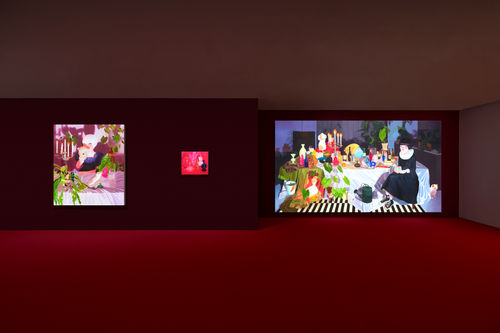
조현화랑_서울은 2025년 12월 17일부터 2026년 2월 8일까지 이소연 개인전 《Love of this Age(이 시대의 사랑)》을 개최한다. 신작 12점으로 구성된 이번 전시에서 이소연은 조현화랑_서울의 응축된 화이트 큐브 공간을 '강렬하고 사적인 방'으로 전환시킨 후, 그간 작가가 축적해온 내면의 기록과 장소의 기억, 그리고 그로부터 생성된 다층적 자아의 페르소나를 소환한다. 최승자 시인의 시집에서 가져온 전시 제목은 시간의 흐름과 변하지 않는 감정의 강도를 포착한 작가의 개인적 경험에서 비롯된 것으로, 전시 전반을 관통하는 정서적 기반을 형성한다. 그 안에서 회화적 틀은 보이지 않는 감각과 시간을 자유롭게 불러오는 매체로서 기능한다.
연지벌레에서 추출한 카민(Carmine)으로 칠해진 검붉은 벽면은 단순한 전시 배경을 넘어 작가의 내밀한 영역을 물리적으로 구현한 장치다. 이 공간 안에서 회화는 평면을 벗어나 하나의 무대이자 체험적 환경으로 확장된다. 화면 속 사물들은 모두 작가가 실제로 소유하고 사용해온 것들이다. 20년 전 암스테르담에서 구입한 촛대, 맥주 양조장 병, 참이슬 소주병, 초록색 데이비드 호크니 서적 —이 오브제들은 작가의 삶을 관통해온 시간의 증거이자, 서로 다른 시대와 장소가 중첩된 기억의 지층을 이룬다. 특히 호크니의 책은 작가에게 결정적 전환점을 상징한다. 작가는 그의 전시를 네 시간 동안 관람하며 받은 충격 이후 작업 방향을 근본적으로 재편했다고 회고한다.
이러한 사적 공간에 초대받은 관객은 촛불 기반의 황금빛 조명과 강렬한 그림자가 만들어내는 몽환적이면서도 극적인 분위기 속으로 들어서게 된다. 물체 만큼이나 강렬한 그림자와 이를 관통하는 빛은 현실과 비현실의 경계를 흐리며, 작가의 지극히 사적인 감정 위로 관객 자신의 감각을 불러일으킨다. 그 중심에서 관객을 응시하는 인물이 등장하는데, 바로 이소연의 자화상이다. 그러나 이 인물은 자화상이라는 전통적 정체성보다는 화면의 서사를 매개하는 장치에 가깝다. 초기 작업과 달리 최근작에서 작가는 얼굴의 그림자를 최소화하고, 표정을 제거하며, 역광 처리를 통해 인물을 중립적 상태로 유지한다. 관객이 자신의 감정을 투사할 여지를 남기기 위한 전략이다. 한편, 넓은 의미에서 화면 속 모든 사물이 작가의 자아를 반영하므로, 이는 확장된 자화상의 개념으로도 읽을 수 있다.
작가의 과거의 기억을 재구성한 이번 전시는 동시에 앞으로의 구조적 변화를 예고한다. 과거 정중앙에 고정되어 있던 인물은 이제 화면 밖으로 이동하고, 자세와 동작이 생기며 구성이 역동적으로 전개된다. 배경 없는 작품에서는 인물이나 사물 하나가 주제이자 중심으로 기능하며 순간의 감정을 직접적으로 제시한다. 반면 배경이 있는 작품에서는 인물, 사물, 색채가 모두 동등한 서사적 주체로 작동하며 화면 전체가 복합적 이야기를 생성한다. 작가는 향후 작업에서 피아노, 말, 대형 식탁 등 스케일이 큰 사물로 확장하고, 설치적이고 입체적 요소를 실험할 계획을 갖고 있다. 색채와 조명의 변화, 그리고 화면 전체가 더욱 드라마틱해진 조형적 선택에서는 자유로움을 되찾고자 하는 열망이 감지된다.
작가는 관객이 작품을 과도하게 해석하기보다 감각적·직관적·본능적으로 접근하기를 권한다. 색, 빛, 그림자, 공간의 분위기가 만들어내는 감각적 총체를 사유하며 경험하는 것, 그것이 이 전시가 제안하는 관람 방식이다.
나에게 회화란 무엇인가? - 이소연
내 그림 속 인물들은 모두 나 자신을 그린 자화상이다. 그러나 그것은 거울 앞에 앉아 그린 전형적인 자화상이 아니다. 내가 경험한 여러 나라와 장소들 속에서 만들어진 다양한 페르소나들이다. 어떤 때는 소녀로, 어떤 때는 낯선 존재로, 또 어떤 때는 가면 같은 얼굴로 표현된다. 그것은 내가 가진 정체성의 여러 층위를 드러낸다. 나에게 회화는 단순히 현실을 베껴내는 기술이 아니다. 보이지 않는 감각이나 시간을 불러오는 매체다. 그 안에서 ‘진짜 나’와 ‘꾸며낸 나’, 즉 ‘개인적인 나’와 ‘사회적 얼굴’이 교차하면서 긴장감을 만든다. 회화는 나에게 일종의 놀이다. 원근이나 색채, 구도와 시점, 인물의 표정까지도 ‘정답’에 맞추기보다 일부러 비틀고 흔들어 보며 내 안의 다양한 자아를 꺼내 보이도록 연출한다. 그래서 나는 이렇게 말하고 싶다. 회화는 마법 같은 언어다. 그리고 그 언어를 통해 나는 수많은 ‘나’를 탐색하고, 다시 세상과 연결된다.” 회화란 무엇일까? 아마 그 질문에 답하기 위해, 그리고 내 안의 수많은 ‘나’를 더 깊이 찾아내기 위해, 나는 앞으로도 계속 그림을 그리고 있을 것이다.
[예술로서의 감정, 이소연의 페르소나]
지극히 사적의 감정으로 예술이라는 공적 토대를 직조하는 방식이란, 개인과 세계의 관계, 그 역사의 과정을 다시금 조망토록 한다. 이는 당연하게도 세계와 개인의 관계를 단순히 집단과 개별의 내면 정서나 심리적 상태의 정도로 이해하는 데에 그치는 것이 아닌, 해당의 관계 및 그 역사를 중심에 둔 주체의 입장, 즉 세계를 향한 주체의 의식 조성 및 그 태도의 상호성과 분명 관련이 있다. 문학적 맥락에서의 소위 ‘인칭’의 사유–그것을 지칭하는 대명사로 나·우리(이상 1인칭), 너·너희(이상 2인칭), 그·그들(이상 3인칭) 따위의–를 경유할 필요라 하면, 몰입의 형태를 통해 역시나 주체로서의 향유를 수행하는 수용자, 이들을 대상으로 삼아 행하는 창작 주체의 미적 의도에 기인하고 있다. 타자를 전제하는 관계론적 인식의 지평으로부터 각기 다른 자아 감각의 수행적 경위를 상정하는 그러한 관점은 곧 감정이 주체 내부에서 자기 연소함으로써, 고정되어 완결하지 않고 타자(그들의 외연이기도 할) 세계라는 차원과의 확장면에서도 감정은 주체 정체성의 원리를 구성하는 주요한 조건으로 스스로를 설정한다. 그렇듯 감정은 다른 한편 개인과 세계가 접촉하는 순간에 이르러서야 비로소 주체 형성을 위한 정동의 기제로 작동한다. ‘페르소나(persona)’의 존재는 바로 정동성의 의인화된 현현이자, 이를 위한 하나의 ‘의사(意思)’라고도 할 수 있겠다.
이소연의 인물은 특정하거나 구체적인 분별의 정보를 실제의 세계에서 명징하게 표상하지는 않지만, 작가는 해당의 인물에 곧 자신의 내면을 투영해 세계와 자아의 관계를 규명하는 자기 표현 행위이자 그것의 통제·관리 방식으로써, 그러한 인물을 바라보는 관람 주체를 위한 ‘공연(performance)’ 형식의 외재화로부터 스스로의 페르소나를 ‘전면(front)’에 구축해 낸다. 이는 어빙 고프먼(Erving Goffman, 1922–1982)이 주창한 ‘극적 실현(dramatic realization)’의 형상화한 판본으로도 해제할 수 있고, 그리하여 이소연은 커뮤니케이션의 대상들이 그에 대한 어떤 이상적(또는 규범적) 인상을 형성할 수 있게 한다.[1] 작가는 인물을 포함, 그의 주변으로 배치하는 일상의 오브제를 ‘관계적 총체(realational totality)’의 일면으로 제시하는 한편, 그렇게 그의 자전적 감정 발화로써 자아(혹은 정신분석학적 지점에서의 ‘자아 감각(sense of self)’)와(과) 세계 사이에 반투명하게 상정된 경계를 조정한다. 여기서 일어나는 공감의 작용은 관람자의 감정에 상호 침투적으로 일으켜지는, 일종의 ‘정동적 공명(affective resonance)’의 실체로서 현전하는 작가, 그리고 그 당사의 페르소나가 맞물리는 상황이자 순간으로 응결하는데, 그처럼 이소연은 인물과 사물을 매개로 사적 감정의 발화를 동시대 정체성의 지형으로 승화하는 미적 연출을 그만의 고유한 회화 문법을 경로로 하여 수행한다. 따라서 작가를 고유하게 대신하는 페르소나는 자체의 존재로 역사적 시간과 공간을 가로지르며 지금까지 창출하고, 또 축적된 개인 기록의 지속적 의미로도 충분하게 받아들여질 수 있을 것이다.
조현화랑 서울에서의 개인전 《이 시대의 사랑(Love of this Age)》(2025)에서 선보이는 작업의 결은 이소연이 그려 온 그동안의 연작들과는 사뭇 차이를 외연한다. 기존에는 그의 심상적 분신을 의인화해 낸 페르소나적 인물, 이들이 처한 상황의 관점을 부각하는, 이른바 ‘각광(spotlight)’의 전략으로부터 그것의 속성을 장면 구성의 주요 방법론으로 채택했다면, 본 전시에서 선보이는 일련의 신작들에서는 그보다 한층 열린 소통의 분위기를 자아내는데, 이는 작가의 삶을 이루는 일상적 오브제들로 이제껏 그의 페르소나가 점유했던 전면의 자리를 대신하기 때문이다. 해당의 대상물은 말 그대로 이소연의 감각을 엿보이는 감각적 수집(collection)의 층위를 축조하는 지지체로, 초현실의 차원에서 실재하던 작가 페르소나의 자리를 지금, 여기에 마련한다. 더불어 소비 기호가 기입된 실상의 기호–브랜드명이 각인된 작가가 직접 향유하는 취향의 상품들–로써, 이렇듯 소비의 체계와 결착된 시각적 전개(〈검은 드레스〉(2025), 〈여우 목도리〉(2025), <양가면〉(2025), 〈검정 가발〉(2025), 〈노란 가발〉(2025)[2]의 경우)는 통상 일정한 거리를 두고 행해지는 관습적 도상 읽기의 시선을 페르소나로부터 거두게 할 뿐만 아니라, 정서적인 은유의 매개를 경유해 현실의 총체를 주체적으로 조직할 수 있도록 하는 상기의 기회를 자연스레 활성화하기도 한다. 그와 같이 화면에서 오브제의 지위를 전면적으로 재편하는 것, 이와 같은 시각적 전개는, 곧 바니타스(vanitas)의 개념–허무하고, 덧없으며, 무상하고, 공허한–으로부터 상징적 교훈을 담지하던 전통적 정물(still life)로서의 장르에서 탈주해 사물 회화의 형식을 당대적으로 갱신키도 하는 것이다. 이처럼 죽은 사물들의 동원이 아닌, 그 자체로 생동하는 무엇–실사용의 대상물이자 작가 소유의 오브제들–이자, 기억의 지층에서 소환되는 파편화된 삶의 흔적들을, 이소연은 그 선명한 장면 현시의 미적 실천으로 응집한다. 그렇게 현상은 다분화된 시공의 의미망 가운데서 새롭게 인식될 수 있으며, 그러한 전환의 동력은, 역시나 그의 세계관 내에서 오브제로 하여금 주체와 세계를 동기화하는 질서의 방식을 재조정케 함(〈병렬 정물〉 연작(모두 2025), 〈노란 병〉(2025), 〈붉은 병〉(2025), 〈안스리움〉(2025)의 경우)에서 비롯된다.
작가 스스로가 밝힌바, 본 개인전의 제목 “이 시대의 사랑”은 시인 최승자가 펴낸 동명의 시집 『이 시대의 사랑』(문학과지성사, 1981)에서 빌려온 것이다.[3] 작품과 전시 등의 제목을 쓸 때, 흥미로운 건, 작가는 특유하게 표면적인 지표의 그것을 우선해 작업을 호명하는 편이었으나, 이와 대비해 이번만큼은 자신의 감정을 표하는 것에 상대적으로 가리거나 숨김이 없는 솔직한 태도를 퍽 가시적으로 드러내었다는 점이다. 이러한 직관적 선택은 주변적 요소로서의 일상과 오브제의 위상을 전시라는 형식에서 주체와 세계를 예술로써 매개하려는 그의 미학적 함의를 되려 현저히 실존적인 국면으로부터 실행함과 다르지 않다. 바로 이러한 맥락에서 작가가 말하고자 하는 ‘사랑’은, 통념적 위계에 한정된 정념이라기보다, 존재의 의미를 둘러싼 초월적 관계의 성립에 더 가까운 의지로 읽혀야 할 테다. 그로부터 이소연의 회화는 예술과 현실 사이를 메운 괴리의 크레바스를 섬세하고도 단호한 형태로 가로질러 내고 있는 것이다.
[1] Erving Goffman, THE PRESENTATION OF SELF IN EVERYDAY LIFE, Edinburgh: University of Edinburgh, Social Sciences Research Centre, 1956.
[2] 본 작품의 경우 작가의 또 다른 출품작 〈양 가면〉(2025)과 함께, 〈Black Forest 3〉(2018)을 통해 재구성된 것으로서의 페르소나 현실에서 인물이 착용한 바 있던 양 가면을 소품화해 당사 일상의 방향으로 침강하게 함으로써, 본래 대립의 구도로 설정되었던 실제와 가상의 경계를 중첩의 방식으로 무화한다는 점에서 인상 깊다.
Johyun Gallery_Seoul presents 《Love of this Age》, a solo exhibition by Lee So Yeun, on view from December 17, 2025 to February 8, 2026. Featuring twelve new works, the exhibition transforms the gallery’s enclosed white cube into a phantasmagoric and private sanctum. Through this spatial intervention, Lee summons layered personas of the self, shaped by accumulated inner records and memories of place. The exhibition title, borrowed from the poetry collection of the renowned poet Choi Seung-ja, resonates with the artist’s personal experience of capturing the flow of time and the unyielding intensity of emotion. This emotional tenor permeates the entire exhibition, where the pictorial frame functions as a medium that freely invokes invisible sensations and time.
The deep crimson walls, painted in Carmine—a vivid red pigment historically extracted from cochineal beetles—serve as a device that transcends a mere exhibition backdrop to physically manifest the artist's intimate interiority. Within this visceral space, painting expands beyond the flat surface to become an experiential stage. The objects depicted are all personal items the artist has owned and used: a candlestick purchased in Amsterdam two decades ago, a brewery bottle, a Chamisul soju bottle, a green David Hockney monograph. These objets stand as evidence of the time that has passed through the artist's life, forming sedimented layers of memories where different eras and places overlap. In particular, Hockney's book marks a decisive turning point for Lee; she recalls a four-hour exhibition visit that shook her to the core, fundamentally reorienting her artistic bearing thereafter.
Visitors are invited into this private, phantasmagoric, yet theatrical atmosphere created by golden, candle-lit shadows. These expressive shadows, as arresting as the objects themselves, and the light piercing through them, blur the boundaries between reality and unreality. This interplay evokes the viewer's own senses, superimposing them atop the artist's private recollections. At the center appears a figure, gazing at the viewer: it is Lee So Yeun's self-portrait. However, this figure is less about the traditional identity of a self-portrait and closer to a narrative device. Unlike her early works, in recent pieces, the artist minimizes facial shadows, removes expression, and maintains the figure in a neutral state through backlit silhouetting. This strategy creates space for viewers to project their own emotions. Meanwhile, in a broad sense, since every object on the screen reflects the artist's ego, the work may also be read as an expanded self-portrait.
Reconstructing the artist's past memories, this exhibition simultaneously prefigures future structural changes. Previously, the figure was fixed center-canvas, but has now shifted—or rather, exited the screen—gaining posture and movement in the dynamic unfolding of the composition. In works without backgrounds, a single figure or object functions as the subject and center, directly presenting the emotion of the moment. Conversely, in works with backgrounds, figures, objects, and colors all operate as equal narrative agents, weaving complex stories across the entire screen. Lee plans to expand into larger objects such as pianos, horses, and large dining tables, and to experiment with installation and sculptural elements in future works. In the changes of color and lighting, and in the formal decisions where the entire screen has become more dramatic, one senses a desire to reclaim greater self-determinacy.
The artist invites the audience to approach the work sensually, intuitively, and instinctively rather than via calculated interpretation, which she deems excessive for her work. To think and experience the sensory whole created by the atmosphere of color, light, shadow, and space—that is the method of viewing appropriate for this exhibition.
What is Painting to Me? – Lee So Yeun
Every figure inhabiting my canvas is a self-portrait. Yet, these are not about the likenesses captured before a mirror. Rather, they are personas forged across the diverse landscapes and nations I have traveled and experienced. Manifesting at times as a young girl, a stranger, or a mask-like visage, they reveal the multiple strata of my identity. For me, painting is not a mere technique of mimetically reproducing reality. It is a medium that summons invisible sensations and accumulated time. Within this pictorial space, the authentic self and the constructed self—the private individual versus the social face—intersect to generate tension. Ultimately, painting is a form of play. Rather than adhering to a correct answer regarding perspective, color, or composition, I deliberately distort and destabilize these elements, staging scenes that coax out the diverse egos within me. Thus, I define painting as a magical language—one through which I navigate the countless versions of the self and reconnect with the world. What is painting? To answer that question, and to excavate the myriad "Is" buried deeper within, I will continue to paint.
[Emotion as Art, Lee So Yeun’s Persona]
Weaving the public foundation of art through deeply private emotions compels us to re-examine the relationship between the individual and the world. This is not merely about contrasting collective history with personal sentiment; rather, it fundamentally concerns the stance of the subject who places that relationship at the center of their consciousness. To understand this, we might look to the literary concept of grammatical personhood, that is the linguistic structure that defines the distance between I (First Person), You (Second Person), and They (Third Person). In Lee So Yeun’s work, emotion functions like this grammar: it is a mechanism of affect that bridges the gap between the creator's private intention and the viewer's public immersion. Emotion here does not stagnate within the private self; instead, it expands outward, establishing the very conditions for identity precisely at the moment of contact with the world. The Persona is the anthropomorphized manifestation of this will—a bridge built to traverse the distance between the self and the Other.
In her practice, Lee So Yeun has long utilized the figure not as a realistic representation, but as a projection of her interiority. To borrow from the sociologist Erving Goffman (1922–1982), she constructs a Front—a term Goffman used to describe the performance space where an individual manages the impression they give to others. Through Dramatic Realization, Lee presents idealized or controlled versions of the self using costumes, masks, and staging, thereby curating the truth the viewer perceives.[1] However, her latest works introduce a relational totality that shifts this dynamic. By blurring the semi-transparent boundary between her sense of self and the external world, she moves beyond mere theatrical performance into a realm of affective resonance. Here, the artist’s presence is not acted out on a stage but felt in the room, sublimating private emotion into a topography of contemporary identity that crosses historical time and space.
The exhibition Love of this Age (2025) at Johyun Gallery Seoul marks a decisive departure from Lee’s previous methodology. In the past, she employed a strategy of the spotlight, highlighting the persona-figure and the dramatic situation they inhabited. In contrast, the new works evoke a far more open atmosphere of communication. This shift occurs because the everyday objects constituting the artist’s life have now usurped the position of the Front once occupied by the figure, transforming from mere accessories into active agents of biographical testimony. These objects—supports for a layer of sensory collection—summon the artist’s persona from the realm of the surreal into the immediate here and now.
Featuring consumer goods imprinted with brand names and specific tastes (such as in Black Dress (2025), Fox Fur Stole (2025), Sheep Mask(2025), Black Wig (2025), Yellow Wig (2025) [2]), Lee compels the viewer to withdraw the conventional iconographic gaze usually reserved for the figure. Instead, these objects naturally activate an opportunity for the viewer to autonomously organize the totality of reality through emotional metaphor. This comprehensive reorganization of the object’s status on the canvas serves as a contemporary renewal of the Vanitas tradition. Unlike historical Vanitas which mobilized dead objects (skulls, rotting fruit) to preach the moral lessons of emptiness and transience, Lee So Yeun aggregates living objects—items of actual use and fragmented traces of life summoned from the layered depths of memory. These are not symbols of death, but aesthetic practices of vivid scene manifestation that prioritize the tactile presence of the living over the symbolism of the dead. Through works like the Parallel Still Life series, the artist readjusts the order that synchronizes the subject and the world, allowing phenomena to be perceived anew within a diversified semantic network of time and space.
As the artist herself has revealed, the title Love of this Age is borrowed from the poetry collection of the same name by Choi Seung-ja (1981).[3] It is telling that Lee, who previously favored titles based on surface indicators, has now chosen one that reveals her emotions without concealment. This intuitive choice elevates the status of everyday life and objects from mere peripheral elements to central agents of meaning. "Love" in this context is not a passion limited by conventional hierarchy, but a fierce existential will to establish a transcendental relationship with the world. From this vantage point, Lee So Yeun’s painting traverses the crevasse between art and reality in a form that is both delicate and resolute.
[1] Erving Goffman, The Presentation of Self in Everyday Life, Edinburgh: University of Edinburgh, Social Sciences Research Centre, 1956.
[2] In the case of this work, along with the artist’s other entry Sheep Mask (2025), it is impressive that the sheep mask—previously worn by the figure in the persona reality reconstructed through Black Forest 3 (2018)—is turned into a prop, causing it to settle toward the artist’s daily life. In doing so, it nullifies the boundary between reality and the virtual through overlapping.
[3] Lee So Yeun, Interview with the author, November 13, 2025.
-Jang Jin-taek (Art Critic)
